Ep. 06: Designing Content that Leads to Paid Offers
This episode is all about my bread and butter, taking a big picture overview of how all of your content fits together.
A lot of folks are posting in threads or in their stories. And while you’re at low capacity, that can help keep momentum flowing, you can work sequentially and, like the messaging is soil metaphor, what you build first can make everything that comes afterward not only easier because you laid the groundwork, but also more effective.
You can be more intentional with what actions you want folks to take because you know where it all leads.
Not all content is created equal.
Types of Content Have Different Purposes
I think this feels common sense and intuitive, but this is what can often lead folks to give up on their marketing because they’re expecting a particular type of content to do something it’s not designed for.
Let’s use reels for example. While some people will talk about how they’re signing clients with them, and let me be clear, I believe them, but it’s just so rare. And in my mind, it says more about the person and their readiness than the content itself.
Remember last episode and when we talked about how the right content can hit someone at the exact right time. This has happened to me with people googling me or watching a couple of my YouTube videos and they booked a call with me. Be grateful when that happens, but don’t expect it.
At least, don’t beat yourself up if some content doesn’t instantly lead to inquiries. You cannot weigh success based on using it as a sales tool. Reels are a tool for discovering you, that’s their purpose. And it for a lot of us, the capacity requirement to make this work may be too high for us to pay.
When you’re devising a marketing strategy, either by yourself or in collaboration with someone like me, there are three questions to answer:
➤ How will new people discover me?
➤ How will I build a relationship with folks who are still considering who to work with?
➤ How will I share next steps for working together to the people who are ready?
One main exception is your website because it serves as a hub. It should have pages for each purpose and, of course, the home page that will hit all of these notes, which is what makes it so tricky.
This ties into overthinking because of the way platform or format-specific marketers, whether intentional or not, can make us feel like we have to choose a silver bullet one type of content that will satisfy all of these purposes. This gets us stuck: we keep searching for that one all-in-one strategy and refuse to commit and let ongoing content build on itself or hold each thing we create to an impossible standard that makes us want to give up.
ACTION STEP
Look at what you’re currently sharing or creating, if anything. We’ll talk about the minimum levels of promotion toward the end of this series, but engaging in folks’ stories or commenting on people’s Threads counts. But we do need to be realistic with the purpose of what we’re currently doing.
Out of those three questions, what are you currently doing, and what are you overthinking the most?
Prioritizing Your Content by Working Backwards
I know that this can feel overwhelming, like I’m asking you to create three types of content every week, but this is just to illustrate how the content ecosystem looks at a high-level. You’re not expected to do all of them at once. Even folks who DON’T have the constraints we do can’t implement all at once.
This is where a roadmap comes in. Software companies use them to prioritize what features they want to add. Features with a bigger impact come first and they’re often needed to be in place before the smaller or lower priority features come later.
This is a concept we can bring to our businesses and marketing. This is why I always start with messaging, because it creates a ripple effect and helps everything else come after it stay consistent and distinctive.
We’re actually going to come back to messaging as we look at our content ecosystem. In the last episodes, we clarified our unique differentiators, but let’s go a step further.
Can you explain your unique approach to the work you do? You can call it your framework, process, or methodology. It can be one you’ve developed yourself, or a blend of others that you’ve trained under or incorporated.
Think folks who use the Enneagram, Human Design, Internal Family Systems, Clifton StrengthsFinder, tarot, or design thinking. I often see it as a mix of these two but any combination is valid.
The first part of your content ecosystem you should prioritize, if you haven’t already done this, is to have pieces that explain the process that you take clients through.
If you think you don’t have a process, it wasn’t until I watched the steps I did with clients that I realized I do have stages and systems I go through to ensure I’m not missing anything. Take note of the patterns you see with clients, the problems they face, and how you address them or tailor your approach. You’d be surprised.
There are several ways you can represent your process:
➤ Page on your website, I’ll link mine in the show notes so you can see one in action
➤ Workshop (don’t have to go in depth here, can just be a high level overview)
➤ Pinned post on Instagram (Featured post on LinkedIn)
➤ Private podcast/video series
➤ Capabilities deck you send to referrals or with proposals
➤ Infographic and visual elements (I’ve included mine in show notes when they’re relevant to what we’re talking about)
Why are these important? From the software example from earlier, having these in place serves a few purposes. You can send some of these to people who are looking to work with you to help them decide if your approach is a good fit for them. I also include a section on my framework on each of my sales pages for this purpose.
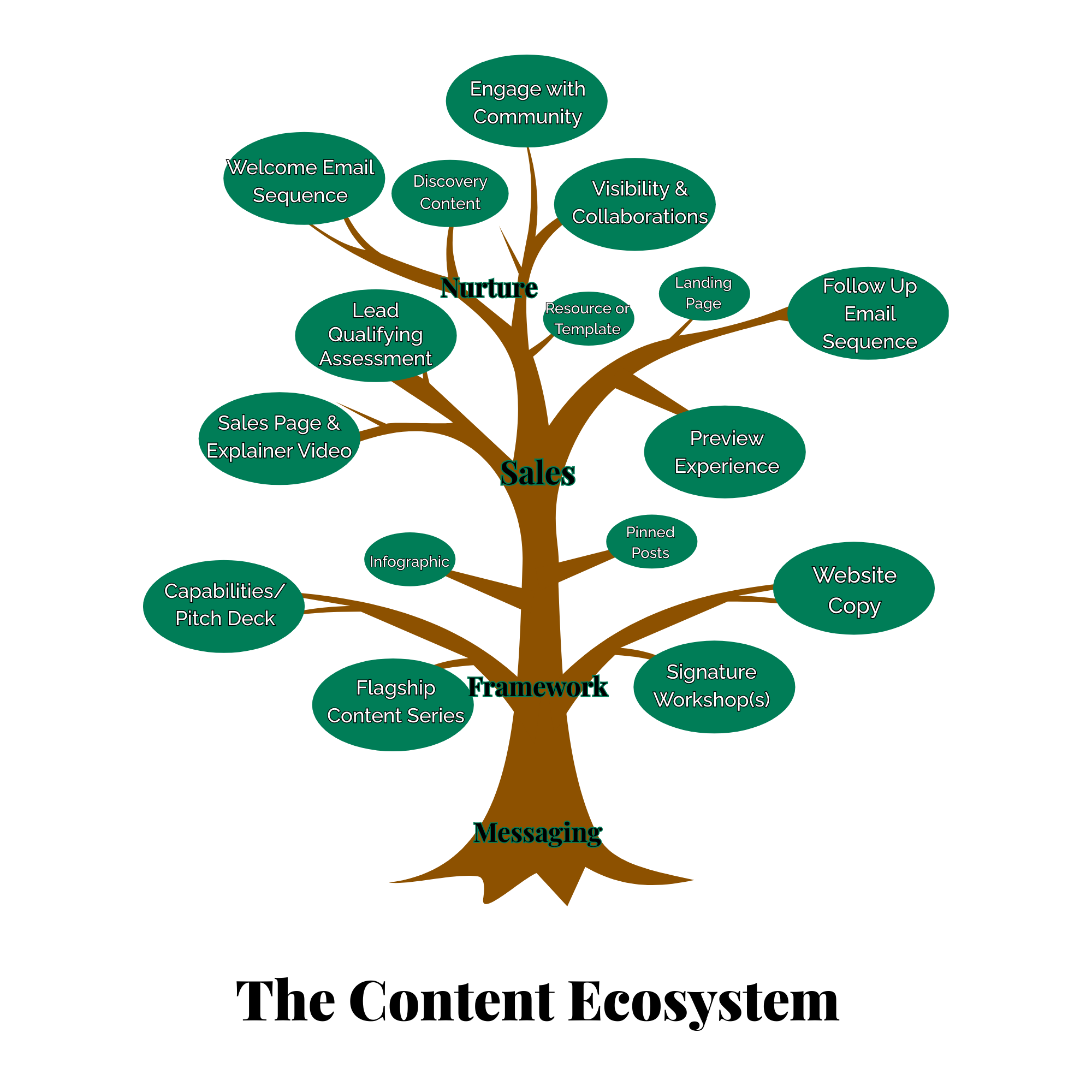
More comprehensive pieces of content can be repurposed into smaller chunks. Creating things like visuals, especially, can be used over and over, as I’m demonstrating in my show notes.
As you define your own process, you also develop that unique spin we discussed in the last episode for your nurture content and get angles to approach your discovery content for podcasts, guest teaching, or speaking.
If messaging is the soil, your approach assets are the seeds that will continue to grow as you work your way through your roadmap.
ACTION STEP
Choose ONE of the above in the list of approach assets to create in the next week or two. It can be as comprehensive or as simple as it needs to be.
I mentioned visual elements because when I was struggling to define some of my own processes for myself, I found that using sketching or opening Canva made my brain think differently about it when I was stuck on how to explain it to someone else. It also helps explain for folks that audio or written may not be the way they process things.
Let’s say you’re not quite there yet. If you’re in the beginning stages of defining this for yourself, use sticky notes, whiteboard, or mind map it. You can design it in a way that’s shareable later.
We’ll talk more about the sales process in the next episode, because after framework design this is the next logical step on the roadmap and maybe the BIGGEST overthinking block us folks that care about our people deal with.